PVC Decorative Film Thickness: Choosing Between 0.12mm and 0.45mm
Published: October 11, 2026 | By GONGDA Team

Thickness is the specification buyers quote first and understand least. It is easy to compare, it sounds like a quality indicator, and it is the single easiest place for a supplier to look generous while changing nothing that matters. A 0.45mm film is not a better film than a 0.25mm film. It is a different film for a different job.
This article sets out what each gauge in our range is actually for, what thickness genuinely changes, and the three places where specifying thicker is simply money spent for no return.
The Range and What Each Gauge Is For
Our decorative film is produced in five standard gauges. Each one exists because a specific process or market needs it.
| Thickness | What it is for | Typical process |
|---|---|---|
| 0.12mm | Economical flat-lamination film where the panel is fully covered and the substrate is smooth | Flat lamination, cold or hot roll |
| 0.18mm | The general-purpose gauge - the largest share of furniture and cabinet volume | Flat lamination, wrapping, membrane pressing |
| 0.25mm | Better opacity and edge concealment; the practical starting point for patterned marble and metallic designs | Lamination, membrane pressing, profile wrapping |
| 0.35mm | Formed and profiled parts, and surfaces that must hide substrate texture | Membrane pressing, profile wrapping, 3D lamination |
| 0.45mm | Deep-draw forming and heavy-wear surfaces; also used where a thicker edge profile must not show through | Deep-draw membrane pressing, post-forming |
Roll length runs 200 to 500m depending on gauge and customer requirement, in jumbo roll widths of 1,000 to 1,400mm with custom slitting.
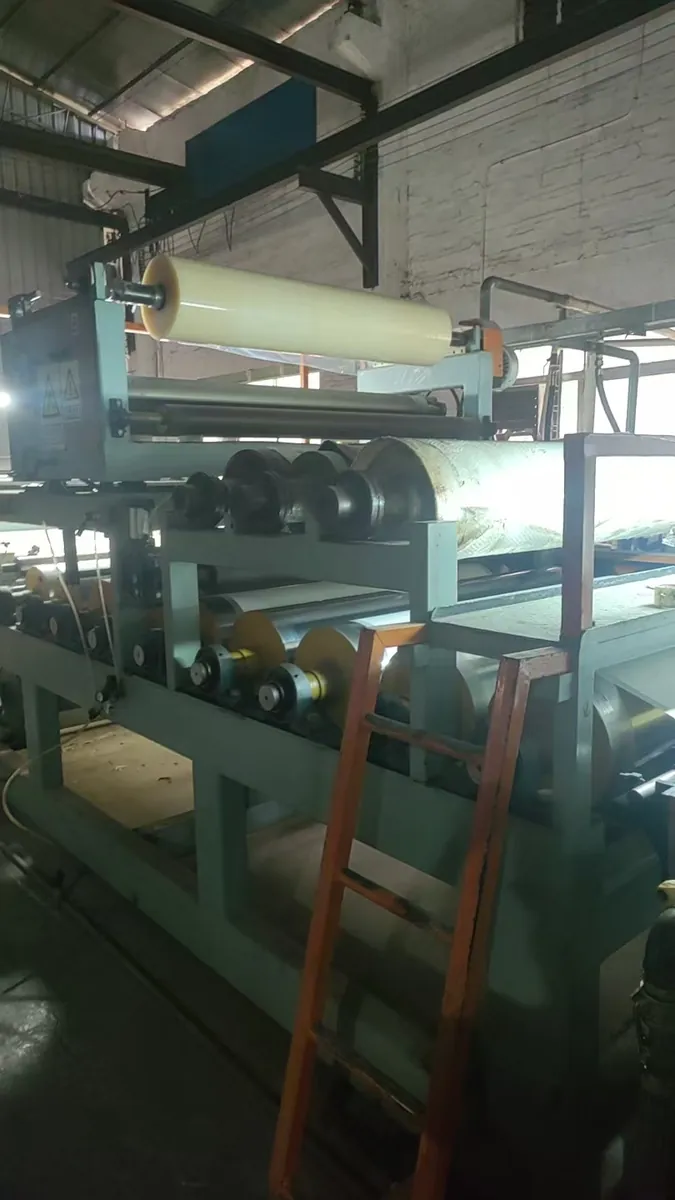
Gauge is set at the calender, so it is a production decision rather than a coating added later.
What Thickness Actually Changes
Five things move when you change gauge, and only some of them are things you want to move.
- Opacity and hiding power. Real and useful. A thicker film covers a darker or more variable substrate with less show-through, which matters most on light solid colours and pale marbles.
- Stiffness and handling. Thicker film is easier to feed flat and less prone to creasing during lamination, but harder to wrap around tight radii and returns.
- Draw depth in vacuum pressing. Deep-draw work needs a grade built for elongation - which is why our membrane foil is offered in 0.25, 0.30, 0.35 and 0.45mm rather than the thinnest gauges.
- Edge concealment. Thicker film hides a slightly proud substrate edge better. It does not fix a badly trimmed one - and the joint itself is a bonding question, covered in our edge banding adhesive guide.
- Weight, roll count and freight. This is the one buyers forget. Doubling the gauge roughly doubles the weight per metre, which halves the roll count a container will carry. That changes your landed cost before it changes anything else.
Three Things Thickness Does Not Fix
1. Surface wear resistance
Abrasion and scratch performance come from the topcoat and the embossing, not the total gauge. Two films of the same thickness from different suppliers can differ substantially in how they survive a kitchen. Specify the abrasion requirement, and let the supplier decide which gauge and topcoat combination meets it.
2. Adhesion
If the film lifts at a wrapped edge, thicker film will lift with more force. Adhesion is a question of glue type, pressing temperature, substrate moisture content and cycle time. Buying a heavier gauge to solve a bond problem is one of the most common and most expensive mistakes in this category.
3. Colour accuracy
Colour comes from the ink system and the pigment, not the film weight. A thicker film with a thin or poorly controlled ink lay will still drift between batches.
Matching Gauge to Process
Working backwards from the process is usually faster than working forwards from the specification sheet.
| Process | Practical gauge | Why |
|---|---|---|
| Flat lamination on a smooth panel | 0.12 - 0.18mm | Full coverage means opacity is not the limiting factor; thin film saves material and freight |
| Wrapping and profile wrapping | 0.18 - 0.25mm | Needs enough body to resist tearing at radii without being too stiff to conform |
| Vacuum membrane pressing (flat to shallow) | 0.18 - 0.25mm | Enough elongation and enough substance to survive the cycle |
| Vacuum membrane pressing (deep draw) | 0.25 - 0.45mm membrane grade | Draw depth is limited by elongation, and deep-draw grades are built for it |
| High-traffic surfaces, light colours | 0.25 - 0.35mm | Opacity and edge concealment matter more than material saving |

Cabinet fronts are where the gauge decision is most visible and least forgiving.
Where Thickness Sits in the Cost Stack
Film is priced by area, so thickness does not change the price per square metre the way buyers expect. What it changes is the weight, and weight is what you pay for at the port. Doubling the gauge roughly doubles the weight of the same order, which halves the number of rolls a container carries. On a long-haul shipment the freight consequence of an unnecessarily heavy gauge can exceed the material difference.
That is the argument for specifying the thinnest gauge that genuinely meets the requirement, and for asking the supplier to justify a recommendation rather than simply quote what you asked for. Gauge is one block of the price; the other four are covered here.
A Selection Checklist
- Name the process first - lamination, wrapping or pressing - and let it set the gauge range.
- Name the abrasion and cleaning expectation, and specify a performance level rather than a thickness.
- State the substrate colour and texture, because that decides the opacity you need.
- Confirm the roll width and length against your line, since wider does not always mean less waste.
- Run a trial in the gauge you intend to order. A 0.18mm sample will not tell you how 0.35mm behaves.
Get the gauge right and everything downstream - adhesion, edge quality, freight - becomes easier. Get it wrong and no amount of process tuning recovers the run.
Next read: How to Apply PVC Film by Vacuum Membrane Pressing: A Complete Guide
Not sure which gauge to specify?
Send the substrate, the process and the finish you are targeting. We will recommend a thickness and send samples in that gauge.
Get a Thickness Recommendation